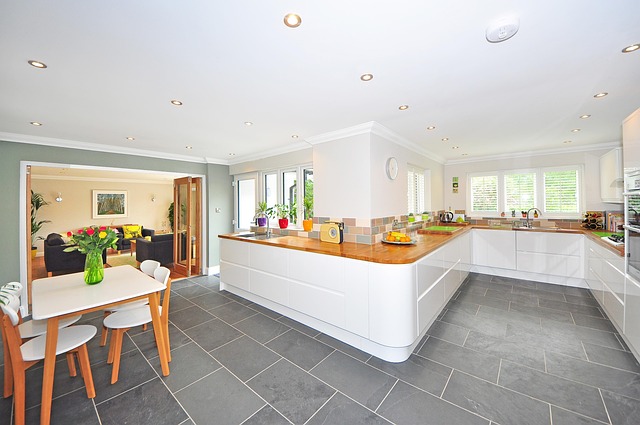
There is a familiar conversation taking place around kitchen tables across South Dublin.
The house needs work. Perhaps the kitchen has become too small, the upstairs bedrooms no longer suit the family, or the heating bills have made another winter in an older property difficult to contemplate. The owners have been thinking about an extension for years, but rising construction costs and uncertainty about the wider economy have made them cautious.
Budget 2027 has given homeowners more to consider, particularly with increased investment in residential energy upgrades and changes to retrofit supports.
Should they proceed with the extension they have been planning, or would it make more sense to improve the insulation first? And could waiting until 2027 make the work more affordable?
For anyone considering a house renovation in Dublin, these are reasonable questions. The answers depend less on Budget headlines than on the condition of the house, the available budget and how the owners intend to live there over the coming years.
Across Rathfarnham, Knocklyon, Terenure and Churchtown, many families already own properties with good proportions, established gardens and excellent locations. The challenge is making those houses suitable for the next twenty years without spending money in the wrong places.
What Does Budget 2027 Actually Mean for Dublin Homeowners Planning Renovations?
Budget 2027 continues substantial Government investment in residential energy upgrades. For homeowners planning renovations, the most relevant measures concern insulation, heating systems and renewable energy, although the availability of funding does not mean every property or proposed improvement will qualify.
The Government’s Budget announcements have been accompanied by changes to SEAI supports intended to make energy improvements more accessible, particularly for households facing higher energy costs.
For homeowners planning substantial building work, the distinction between an energy upgrade and a conventional extension is important.
Energy grants may support eligible improvements within a larger renovation, but homeowners still need to budget separately for the extension, kitchen and other work outside the scheme.
A family renovating a 1960s semi-detached house might, for example, qualify for assistance with particular insulation or heating measures while funding the structural extension, new kitchen and interior finishes themselves.
The relevant eligibility conditions, application procedures and approved works should be checked before the project is committed to.
Should You Renovate Your Dublin Home Now or Wait Until 2027?
For many homeowners, the timing of a renovation has as much to do with family life as it does with the construction market. The condition of the property, the household’s requirements and whether the project is properly planned are usually more useful starting points than the calendar.
A family may have spent several years discussing an extension without quite finding the right moment.
There is always another expense to consider, another school year approaching or another reason to postpone the disruption.
But delay has its own consequences.
Another year with the dining room serving as an office. Another winter heating rooms that never seem particularly warm. Another summer with a kitchen that opens onto the garden through a narrow back door.
Those inconveniences may be manageable, but they deserve to be part of the decision.
If the design is ready, the budget is realistic and the work is necessary, waiting purely in the hope of lower construction prices may achieve little. There is no guarantee that labour or material costs will fall in 2027.
Where a substantial energy retrofit is involved, the timing of grant applications and approval may influence the programme. It is worth establishing those requirements before agreeing a construction start date.
The better question is whether the household and the property are ready for the work.
What New SEAI Grants Could Help Homeowners Improve Their Houses in 2027?
The Government announced enhanced residential energy supports in September 2026, including additional assistance for certain households installing insulation and solar technology, a €2,000 boiler scrappage grant linked to qualifying renewable heating upgrades, and support for domestic battery storage.
According to the SEAI announcement on enhanced energy grants, the measures include increased support for certain households receiving qualifying social protection payments and for eligible properties participating in specified housing schemes.
The package also provides for a €600 domestic battery storage grant. SEAI’s battery storage grant guidance specifies a minimum eligible battery capacity of 5kWh.
The boiler scrappage measure is intended to support eligible households moving away from fossil fuel heating systems. It is not a grant for installing another oil or gas boiler. Homeowners should consult the SEAI eligibility guidance before making decisions about replacing their existing heating system.
For the owner of an older Dublin property, however, the important question is not simply which grants are available. It is which improvements the house actually needs.
A property with poorly insulated external walls may benefit from addressing heat loss before investing in additional technology. Another house may already have reasonable insulation but an inefficient heating system approaching the end of its useful life.
The correct sequence depends on the building.
Grant announcements should not be treated as confirmation that funding has been approved for a particular household. Eligibility, application timing, contractor requirements and scheme conditions must be checked, particularly where the work forms part of a larger renovation.
Why Are Energy Retrofits Becoming Part of the House Renovation Conversation?
Energy retrofits are increasingly considered alongside house renovations because the insulation, heating and ventilation of the original property can have a considerable influence on how the finished home feels.
Many older houses around South Dublin were built when expectations about energy performance were very different.
A 1930s house in Terenure may have generous reception rooms and attractive original features but substantial heat loss. A 1960s property in Rathfarnham may have a practical layout and a long garden yet remain difficult to heat during winter.
The issue becomes particularly noticeable when a new extension is attached to an older house.
The extension may be built to contemporary standards, with well-insulated walls, modern glazing and efficient heating. Meanwhile, the original sitting room and bedrooms may remain much as they were decades earlier, with draughts, inadequate insulation and uneven temperatures.
It makes sense to consider those shortcomings while the wider renovation is being planned.
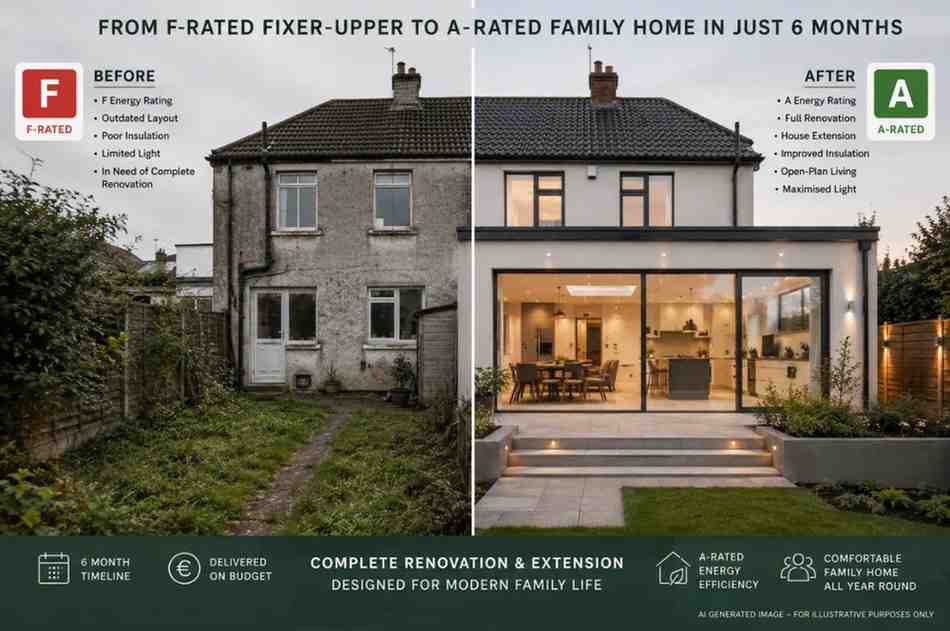
One example from Greenoak’s own work is the full renovation and extension completed for Daragh and Caragh McMahon.
Their property required a complete renovation, extension and modernisation. It had an F energy rating when purchased and, according to the homeowners’ published account, achieved an A rating following the work.
The family had two firm requirements: a six-month deadline and a budget that could not overrun. Planning began before the property purchase was completed, allowing the team to start immediately after the sale closed. The homeowners reported that the project was completed within the agreed programme and budget.
That was the outcome of a substantial, carefully planned project. It should not be taken as a typical timetable or a guaranteed BER improvement for other renovations.
What the example illustrates is the value of considering the existing building, proposed extension and energy improvements together, rather than treating them as unrelated projects.
Is a House Extension Still Worth the Investment in Dublin?
A well-designed house extension can be worthwhile when it addresses genuine shortcomings in the existing property. Also important is that the cost is proportionate to the home and its location. The additional floor area matters, but so does what happens to the rooms already there.
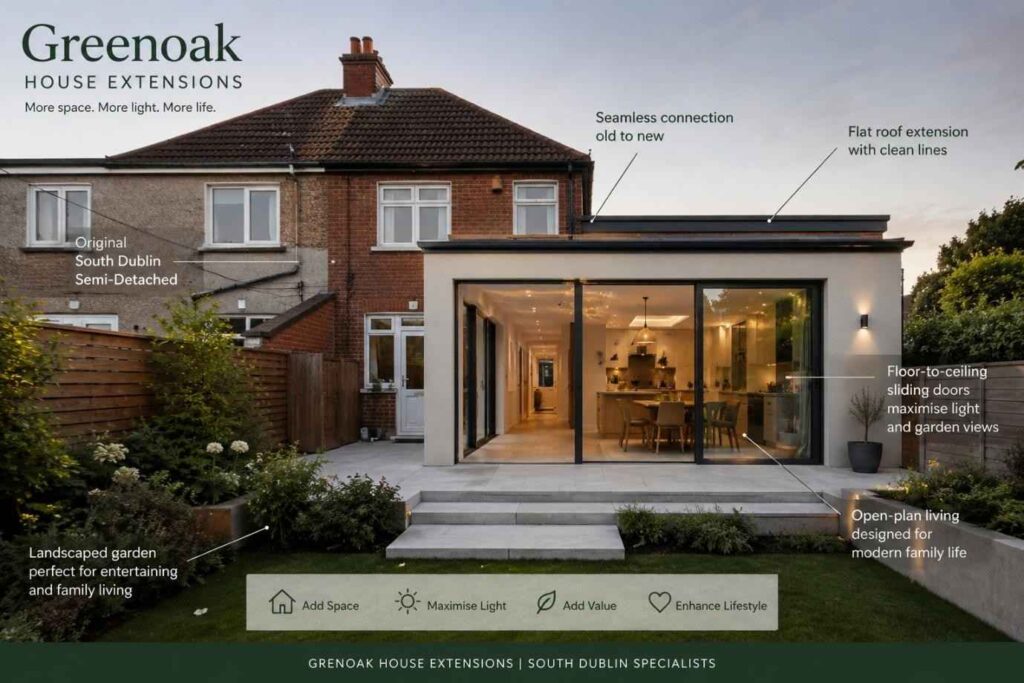
There is a particular type of property found throughout South Dublin that lends itself well to thoughtful extension.
The traditional semi-detached house with a front sitting room, separate dining room, narrow hallway and kitchen overlooking a long rear garden.
These houses often have more possibilities than their existing layouts suggest.
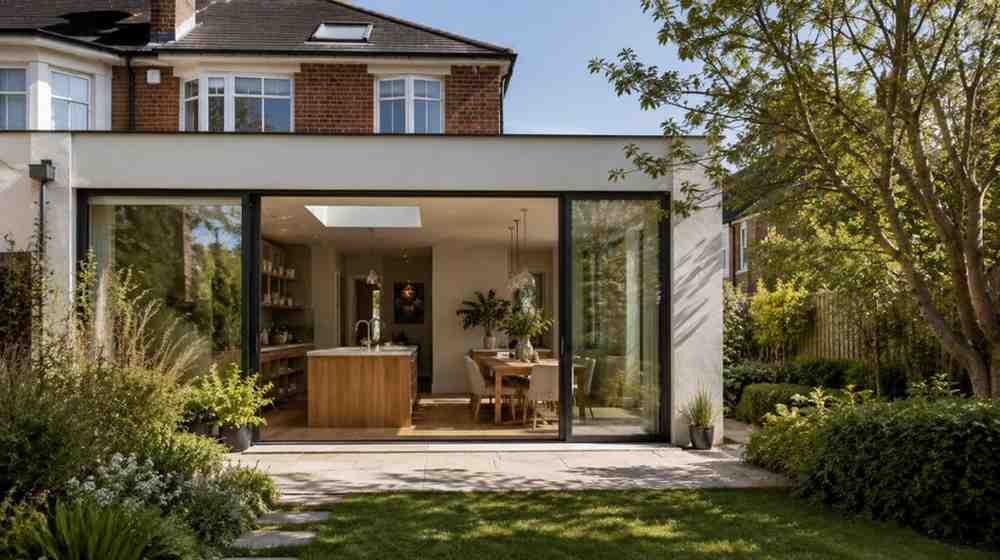
A modest rear extension can create a larger kitchen and dining area while allowing the original rooms to take on more useful roles. The former dining room might become a snug, a side passage could accommodate a utility area, and a carefully positioned kitchen could improve the connection with the garden.
The amount of new construction may be relatively modest, yet the improvement to everyday life can be substantial.
For homeowners researching home extension costs in Dublin, that distinction is worth remembering.
The best use of a renovation budget is not always to build the largest extension the site can accommodate. Sometimes it is to build slightly less and spend more carefully on insulation, glazing, joinery and the parts of the original house that also need attention.
Will Construction Costs Fall in 2027?
The cost of a residential renovation depends on far more than general construction market conditions. Labour, materials, site access, structural alterations and the condition of the existing property all influence the final quotation.
A small residential renovation can involve challenges that are not immediately apparent from the drawings.
Access to the rear garden may be restricted. Structural alterations may require more work than initially expected. Existing drainage might need attention, while the age of the property can influence how much preparation is required before the new construction begins.
Two apparently similar extensions can therefore have noticeably different costs.
This is why detailed specifications matter more than broad estimates based solely on square metres.
Homeowners should understand what is included in their quotation, which finishes have been allowed for, whether important items remain provisional and how changes will be handled once construction begins.
It is also sensible to maintain an appropriate contingency for unforeseen conditions, particularly in older properties.
Could Improving Your BER Make Your Dublin Home More Attractive to Buyers?
A stronger Building Energy Rating can make a property more attractive to buyers by providing clearer information about its energy performance. Irish research has identified an association between better BER ratings and higher achieved sale prices, although location, condition and available space remain important factors.
In August 2026, the Sustainable Energy Authority of Ireland published an analysis of almost 50,000 homes sold during 2023 and 2024.
The SEAI research on BER ratings and Irish property sale prices found that each improvement on the former 15-point BER scale was associated with an average 2.7% increase in achieved sale prices nationally.
For urban Dublin, the reported association was lower, at 1.7% per step.
Those figures describe a statistical relationship across the properties studied. They are not a forecast of how much value a particular renovation will add.
The findings are nevertheless relevant to homeowners considering energy improvements.
Prospective purchasers can see a property’s BER before arranging a viewing. A house that has already undergone substantial insulation and heating improvements may compare favourably with a similar property requiring significant additional work.
Buyers of older Dublin houses are often trying to estimate what they may need to spend after purchase. A newly renovated kitchen is attractive, but the condition of the roof, windows, insulation and heating system can influence how comfortable they feel with the asking price.
For owners intending to remain in their homes, the more immediate consideration is usually comfort. A properly planned energy upgrade may make rooms easier to heat and more pleasant to occupy, even if the financial return is difficult to calculate in advance.
Are Garden Rooms and Attic Conversions Worth Considering Instead of an Extension?
Garden rooms and attic conversions can offer alternatives to traditional extensions when the main requirement is a separate workspace or additional usable accommodation. Their suitability depends on the property, the intended use and the planning and building requirements that apply.
Not every family needs a larger kitchen.
Sometimes the difficulty is that too many activities are competing for the same rooms.
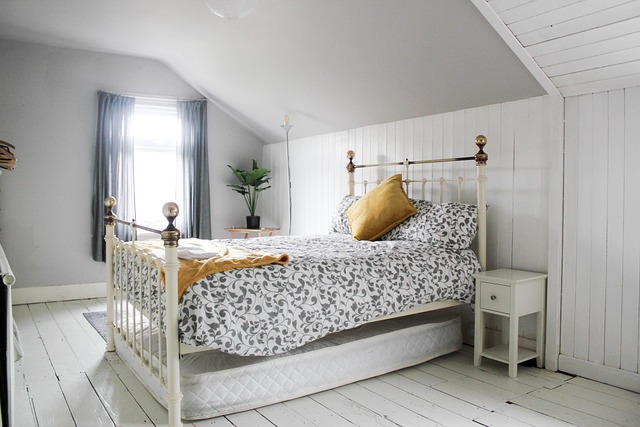
A garden room may provide a useful home office without altering the main house. An attic conversion may create additional space while preserving the rear garden.
Greenoak’s work includes dormer attic conversions and garden rooms alongside traditional house extensions, reflecting the different ways homeowners can make better use of an existing property.
Budget 2027 also included proposals concerning Rent-a-Room Relief and certain auxiliary dwellings.
The announced changes included an increase in the annual relief threshold from €14,000 to €16,000 from January 2027 and an extension of the relief to qualifying designated auxiliary dwellings.
These proposals should not be interpreted as meaning that an ordinary garden office automatically qualifies as rental accommodation.
Planning status, building requirements, the legal definition of qualifying accommodation and the applicable tax conditions must be considered separately.
Homeowners exploring independent accommodation should check the latest Revenue guidance on Rent-a-Room Relief and obtain appropriate planning and tax advice before making financial assumptions about rental income.
What Should Homeowners Prioritise Before Starting a Major Renovation?
Before committing to a substantial renovation, homeowners should establish what the existing house needs and how the proposed work will be carried out. The most useful preparation is often concerned with matters that will be concealed once the rooms are finished.
A practical starting checklist is:
- Structural condition: Assess the roof, existing structure and any proposed alterations, including walls that may need to be removed or openings that will be enlarged.
- Layout: Decide what each room needs to do and whether the proposed extension makes better use of the existing space.
- Energy performance: Consider insulation, heating and ventilation requirements before the design and construction sequence are finalised.
- Scope and budget: Establish what is included in the work, what remains to be specified and what contingency is available for unforeseen conditions.
- Order of work: Identify the structural, electrical, plumbing and energy improvements that should be completed before kitchens, flooring and decorative finishes are installed.
These are not always the most enjoyable parts of planning a renovation, but they are much easier to address before the house is finished.
Is 2027 the Right Year to Invest in Your Existing Dublin Home?
For many Dublin homeowners, 2027 may be a sensible time to improve an existing property, particularly where renovation can address longstanding problems with space, layout or energy performance. The decision should rest on the condition of the house, the household’s priorities and a realistic budget.
There is understandable interest in the latest Budget measures.
Additional energy funding is welcome, particularly for households facing the expense of improving older properties. The growing emphasis on insulation and heating performance also reflects a wider change in how Irish homeowners think about renovation.
But grants should support good decisions rather than determine them.
An unnecessary upgrade does not become worthwhile simply because a subsidy is available. Equally, necessary work should not automatically be postponed because a more generous scheme might appear in the future.
There is something reassuring about the established residential streets of South Dublin. The houses may need updating, but the neighbourhoods have matured around them. Gardens are established, schools and amenities are familiar, and families often have strong reasons to remain where they are.
A carefully planned renovation can allow them to do exactly that.
The most important questions remain remarkably ordinary. Does the house have enough room? Is it comfortable? Does the layout make sense? Will the proposed work improve the property for the people who intend to live there?
Those are the questions worth answering before deciding how much to build or which improvements to undertake.
What Should You Do Before Making a Final Renovation Decision?
If you’re considering a house extension, full renovation or energy upgrade in South Dublin, it is worth discussing the existing property and the proposed work before the design and budget become fixed.
Greenoak’s experience with older Dublin houses, extensions and energy improvements provides a practical starting point for that conversation.
You can explore Greenoak’s completed renovation and extension projects or read its article about what it is really like to live through a Dublin house renovation.
Understanding what the existing house can accommodate, what needs attention and what the work is likely to involve is a sensible place to begin.
AI assisted in preparing this article, which was edited and reviewed by Peter Lawless on behalf of Greenoak Construction.